This year's plan is last year's plan
Coverage is carried forward by habit, and there is no record showing why one area was audited and another was not.
A plan built on risk, approved on record, and assigned process by process for execution
Internal audit is judged twice — once on whether the plan covered what mattered, and again on whether the file supports the report. This module holds both ends. The plan is built from the audit universe and risk factor scoring, with assurance mapping available where you want to see what other providers already cover, and it goes through formal approval. Once approved, it is assigned process-wise, and from that point the steps are the same ones a control testing run follows — project, RCM upload, IDR release, testing, approval, management response, approval and report — so the plan and the evidence behind it stay in one line.
Most teams know how to do this work. The trouble is that it lives in workbooks, mail threads and shared folders, and keeping them in sync becomes a job of its own.
Coverage is carried forward by habit, and there is no record showing why one area was audited and another was not.
Assignments change through the year without a record, so what the committee approved and what was actually done are reconciled from memory.
The plan sits in one place and the testing file in another, so coverage status has to be collated rather than read.
Without a view of what management testing, external audit or a regulator already covers, effort goes into areas that are already assured.
Build the audit universe, score it on risk factors, map existing assurance where required, and take the plan through approval. Once approved, the plan is assigned process-wise, and from there each process follows the same steps as a control testing run — project, RCM, IDR, testing, approval, management response, approval and report.
A maintained library of auditable entities — processes, locations, subsidiaries, systems and projects — with the attributes used to rank them.
Score each auditable entity on weighted risk factors, drawing current ratings from the ERM register, so the ranking reflects the same risk view the board sees.
Where you want it, map significant risks to the assurance they already receive — management testing, control testing, external and statutory audit, regulatory inspection — so the plan is set on where assurance is missing rather than on where it is easiest to repeat.
Turn the ranked universe into a plan with periods, teams and effort, drawn from the scoring and the assurance view rather than from last year's list.
The plan goes through formal approval before execution, and the approved version is the baseline against which the year is measured.
The approved plan is broken down process by process and assigned to teams with periods and timelines, so every line has a named owner and a date.
From assignment onward the steps are the same ones a control testing run follows — a project is created, the RCM is uploaded, the IDR is released, testing is done and approved, the management response is filled and approved, and the report is generated.
Track plan versus actual coverage, the status of each assigned process and observations arising, across the year rather than at the end of it.
Screenshots taken from the live product.
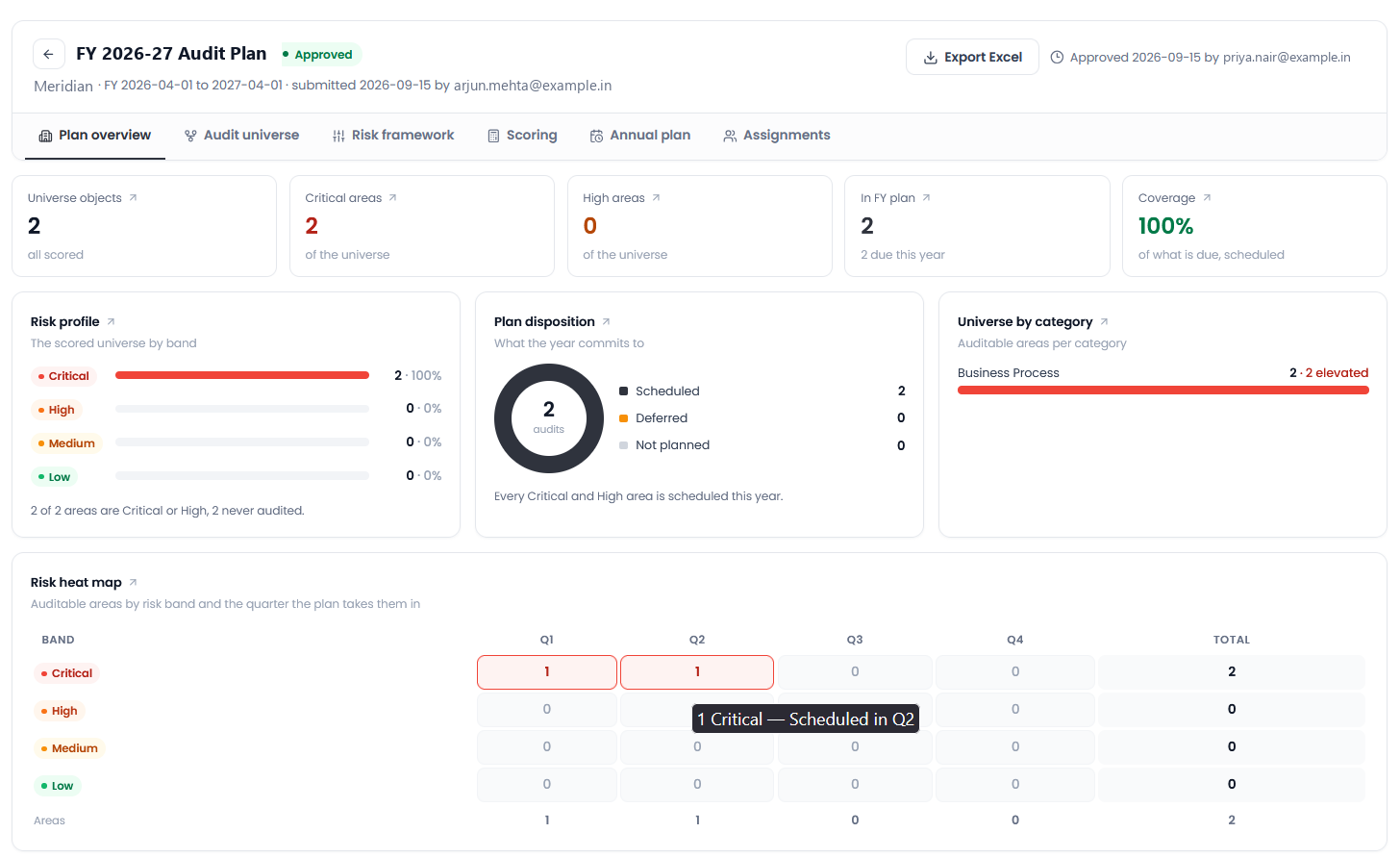
The plan overview reads the way the plan is built — audit universe, risk framework, scoring, annual plan and assignments across the top, and underneath it the scored universe by band, what the year commits to, and the quarter each auditable area falls in. The approval is stamped on the record with who submitted it and who approved it.
The steps in the order your team will actually work through them.
Define and maintain auditable entities, each with its owner, its prior coverage and the risks it carries.
Apply the weighted risk factors and the current ratings from the register, and rank the universe on the result.
Where the coverage picture matters, set the ranked universe against the assurance each risk already receives from management, external audit and regulators before committing audit effort.
Convert the ranking into a periodised plan with teams and effort, carrying the scoring rationale with it.
The plan is formally approved and becomes the baseline for the year, with the approval recorded.
Break the approved plan down by process and assign each one to a team with its period and timeline.
From here the steps are the same as a control testing run — create the project, upload the RCM, release the IDR, test, approve the testing, fill the management response, approve it and generate the report.
Observations and agreed actions from the executed processes go to the Action Taken Report module and are closed against evidence.
The records the module produces, and the regulations and frameworks they help you meet.
These references describe the context the module is designed to support. They are not a statement of certification, and do not replace professional judgement on your reporting obligations.
Everyone works on the same record. Each person sees the part they are responsible for.
Don't see your question here? Write to us and we'll answer it for your setup.
From the audit universe, scored on your weighted risk factors with current ratings pulled from the risk register. Assurance mapping can be added where you want to see what management testing, external audit or a regulator already covers before internal audit commits effort — it is an optional step, not a required one.
The approved plan is assigned process-wise, with a team, a period and a timeline against each process. From there the steps are the same ones a control testing run follows — project creation, RCM upload, IDR release, testing, approval, management response, approval and report.
No. The assignment links the plan line to the project that executes it, so coverage status, testing status and the report all read back to the approved plan instead of being collated separately.
Yes, and they are tracked against the approved baseline rather than replacing it, so the committee can see what was approved, what changed and why.
Observations and the actions management commits to in the response step flow into the Action Taken Report module, where each is tracked to an evidence-backed closure.
Book an hour with our team. We will run the module on your own process and control matrix, so you can see how a full cycle would look for you.