The ATR is rebuilt every quarter
Someone collates status from several trackers and a mail chain each cycle, and the version presented is only as good as that week's responses.
Every observation, from any source, tracked to an evidence-backed closure
The Action Taken Report is the part of governance that most often runs on email. This module makes it a register instead: every observation — from internal audit, control testing, statutory and tax audit, regulatory inspection or management review — becomes an action with an owner, a due date and a defined closure standard. Closure requires evidence and a reviewer's acceptance, and the quarterly ATR is produced from the register rather than compiled the week before the meeting.
Most teams know how to do this work. The trouble is that it lives in workbooks, mail threads and shared folders, and keeping them in sync becomes a job of its own.
Someone collates status from several trackers and a mail chain each cycle, and the version presented is only as good as that week's responses.
Internal audit, statutory audit, tax and regulatory observations sit in separate files, so nobody sees the total open position for a process owner.
An item is marked closed on a verbal confirmation, and the same issue is raised again at the next audit.
Nothing escalates on its own, so slippage is discovered in the meeting rather than in the month it happened.
Turn audit observations and control failures into owned actions with due dates, then track them to closure. The ATR is generated from live status instead of being re-compiled by hand each cycle.
Observations from internal audit, control testing, statutory and tax audit, regulatory inspection, management review and risk treatment all land in the same register with their source retained.
Every action carries an individual owner, a reviewer and an agreed date — not a department and a quarter.
Carry the rating from the originating observation so the register can be read by severity rather than by volume.
Owners are reminded before the due date and after it, and continued slippage escalates to the reviewer and the function head on a defined ladder.
The owner submits closure evidence, the reviewer accepts or returns it, and closure is recorded only on acceptance.
Where a date genuinely has to move, the extension is requested with a reason and approved — and the original date stays visible.
A new observation can be linked to a closed one, so repeats are visible as repeats and the closure that did not hold is on record.
Ageing buckets, owner-wise positions and closure trends render live, and the formal ATR is generated for any period without re-collation.
Screenshots taken from the live product.
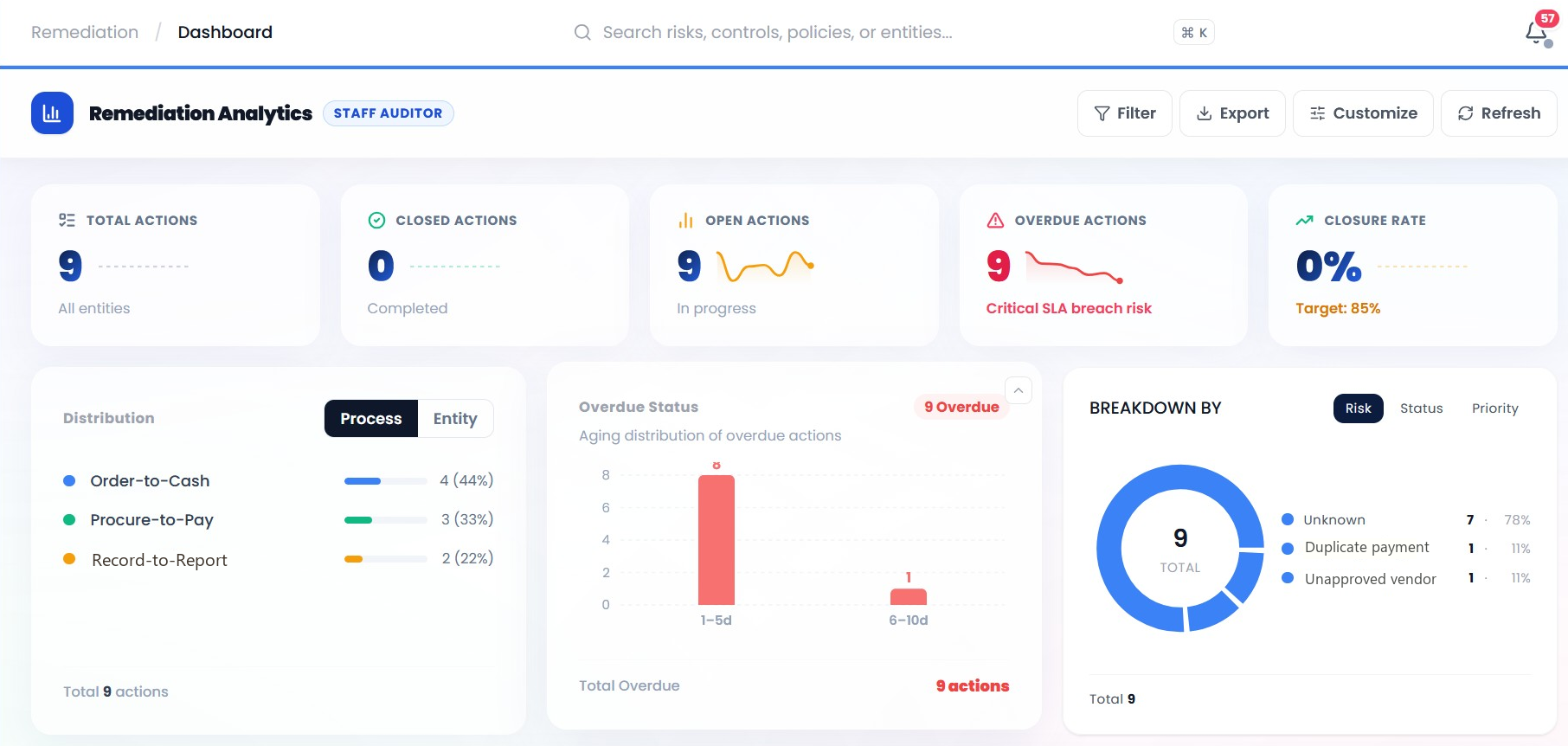
Total, closed, open and overdue actions with the closure rate against its target — the four numbers an Audit Committee asks for first — and underneath them the actions split by process, the ageing of what is overdue in day bands, and a breakdown that switches between risk, status and priority.
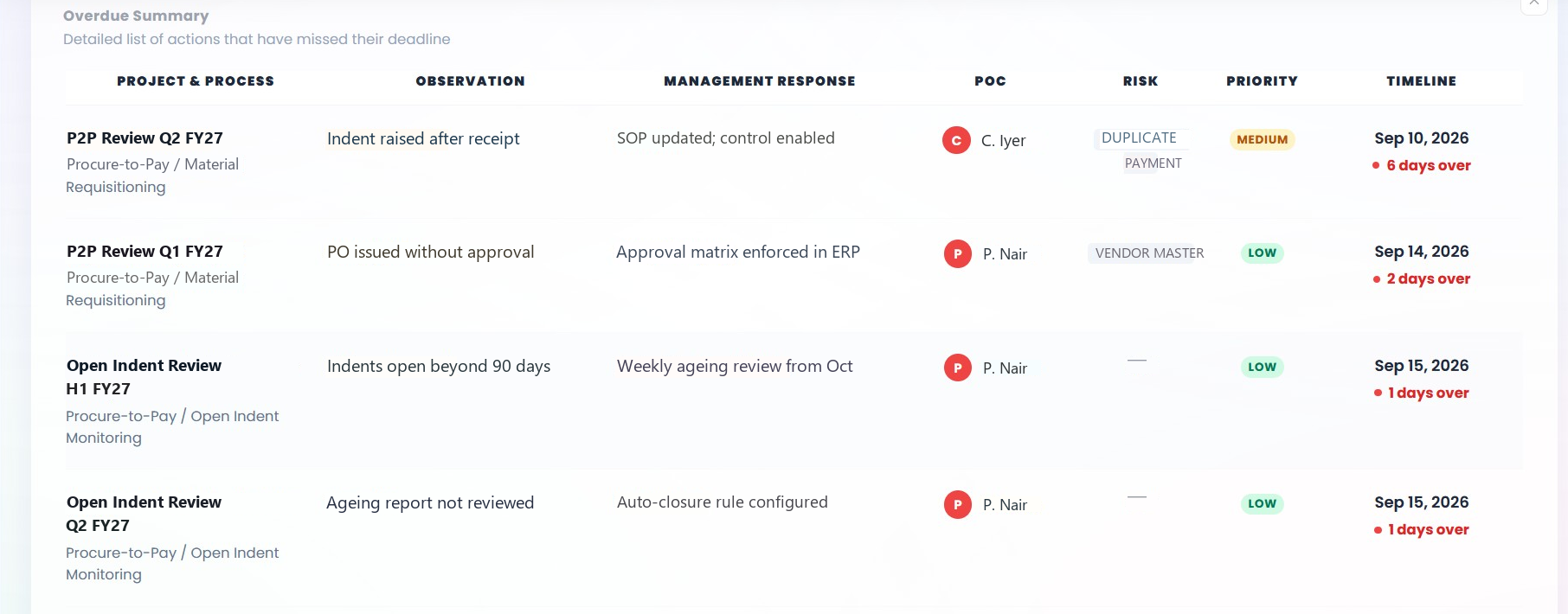
Each overdue action with the observation behind it, the response management committed to, the named point of contact, the risk and priority, and exactly how far past the agreed date it has run — the register the Action Taken Report is generated from.
The steps in the order your team will actually work through them.
Observations arrive from internal audit, control testing and external sources, carrying their reference and rating.
An owner, a reviewer and an agreed date are recorded, along with the action management has committed to.
Owners update progress against the action, with reminders running before and after the due date.
The owner submits the evidence that supports closure rather than a status statement.
The reviewer accepts the evidence and closes the item, or returns it with comments and a revised date.
The ATR, the ageing analysis and the repeat-observation summary are generated for the Audit Committee from live status.
The records the module produces, and the regulations and frameworks they help you meet.
These references describe the context the module is designed to support. They are not a statement of certification, and do not replace professional judgement on your reporting obligations.
Everyone works on the same record. Each person sees the part they are responsible for.
Don't see your question here? Write to us and we'll answer it for your setup.
Yes. Statutory audit, tax audit, regulatory inspection, management review and risk treatment actions can all be recorded with their own source reference, so the committee sees one consolidated position.
Owners submit closure with evidence; closure itself is recorded only when the designated reviewer accepts that evidence. Returns are logged with comments, so the history of a disputed closure is visible.
It is generated from the register for the period selected, with the opening position, movements, closures and remaining open items, so the pack reconciles to live data rather than to a separately maintained sheet.
Yes. Reminders run before and after the due date, and an escalation ladder notifies the reviewer and the function head as an item ages past defined thresholds.
Book an hour with our team. We will run the module on your own process and control matrix, so you can see how a full cycle would look for you.