The RCM is a workbook nobody owns
Process changes are not reflected, control descriptions drift from what is actually performed, and two versions of the matrix circulate at once.
Project to report: the RCM, the requests, the testing, the responses and the sign-offs in one run
Control testing is a defined run, not a collection of files. A project is created for the entity and period, the RCM is uploaded to it, the IDR goes out to process owners for the information and documents required, the team tests against what comes back, the reviewer approves the results, management fills its response on what failed, that response is approved, and the report is generated from the approved record — so the file that supports the conclusion is built while the work happens rather than assembled after it.
Most teams know how to do this work. The trouble is that it lives in workbooks, mail threads and shared folders, and keeping them in sync becomes a job of its own.
Process changes are not reflected, control descriptions drift from what is actually performed, and two versions of the matrix circulate at once.
Information and documents are chased over mail, so nobody can say what has been requested, what has arrived and what is still pending on the day it is asked.
Responses are collected in a separate sheet after testing is done, and the link between the exception, the response and the person who accepted it is held together by hand.
Results, exceptions and responses are re-keyed into a report at the end, so the report and the working file can drift apart.
Create a testing project, upload the RCM, release the information and document requests, test the controls, approve the results, collect the management response and generate the report — with the evidence attached at every step.
Each round of testing runs as a project — entity, process scope, period, team and timeline defined up front, so the work has a boundary and a status of its own.
Upload the risk and control matrix into the project — process, sub-process, risk, control and the attributes that drive testing — instead of maintaining it alongside in a workbook.
Release the IDR from the project to the process owners, with what is required against which control and by when, so the request list is a tracked register rather than a mail thread.
Test design and operating effectiveness against the uploaded RCM, recording the sample, the attributes tested and the conclusion on each control.
What comes back against the IDR attaches to the control and the sample item it supports, so the conclusion and its evidence never travel separately.
Testing is submitted for review, and the reviewer approves or returns it with comments before anything goes to management.
Process owners fill the management response against each exception — the reason, the action committed and the date — inside the project rather than in a separate sheet.
The management response is reviewed and approved, and the report is generated from the approved testing and responses.
Screenshots taken from the live product.
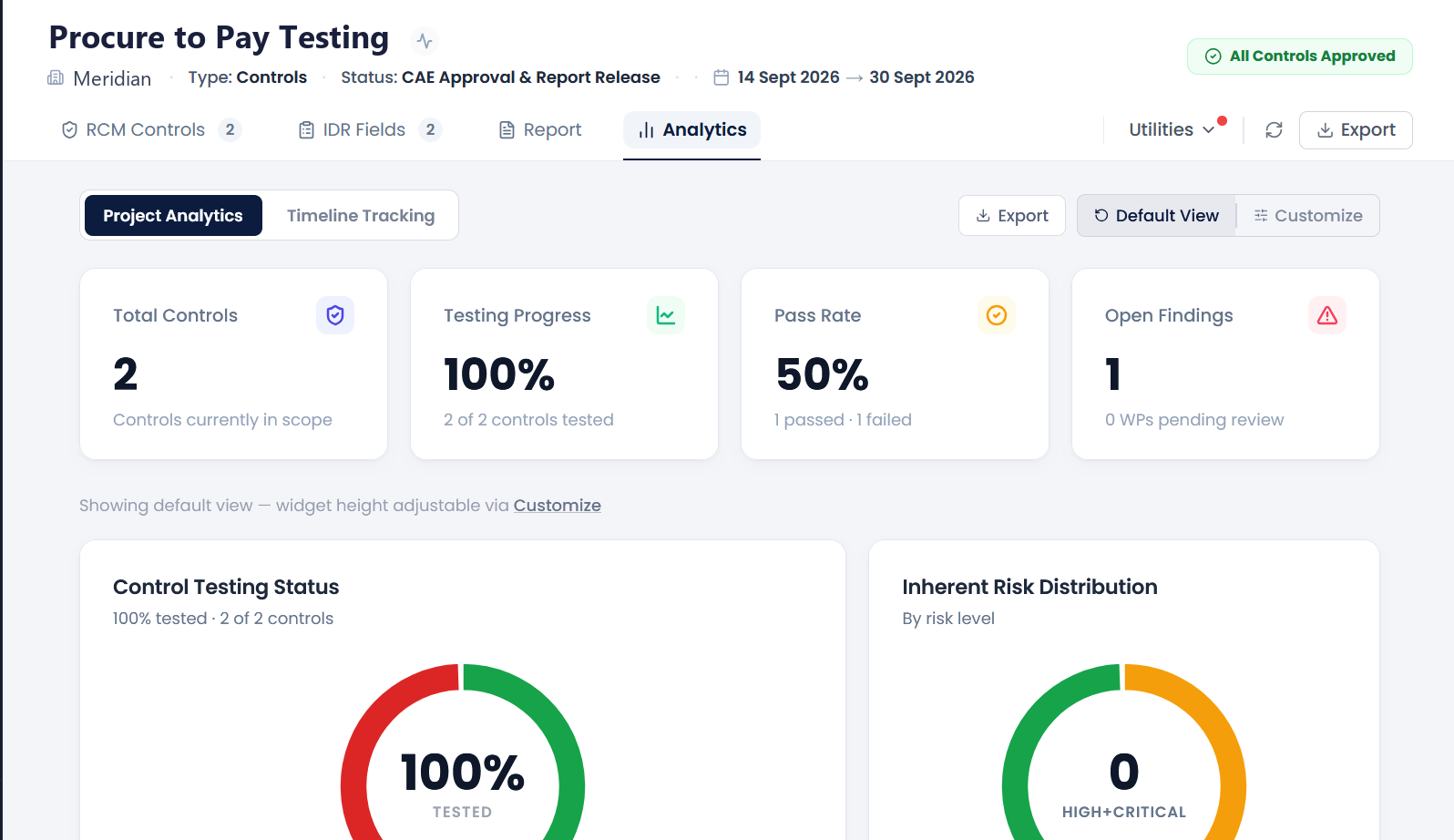
One project carries the RCM controls and the IDR fields raised against them, the report, and the analytics that read off both — controls in scope, testing progress, pass rate and open findings — with the project's own status line showing where it has reached in the approval and report release run.
The steps in the order your team will actually work through them.
Set up the testing project for the entity, process scope and period, with the team, the reviewer and the timeline defined.
Load the risk and control matrix into the project, with each control's attributes, frequency and owner.
Send the information and document requests to process owners against the controls to be tested, with due dates, and track what comes back.
Test design and operating effectiveness on the samples selected, attach the evidence received and conclude on each control.
The reviewer examines the testing and either approves it or returns it with comments for rework.
Process owners record the MR against each exception — the explanation, the action committed and the date by which it will be done.
The management response is reviewed and approved, or sent back for revision where it does not address the exception.
The report is produced from the approved testing and the approved responses, and stays attached to the project that produced it.
The records the module produces, and the regulations and frameworks they help you meet.
These references describe the context the module is designed to support. They are not a statement of certification, and do not replace professional judgement on your reporting obligations.
Everyone works on the same record. Each person sees the part they are responsible for.
Don't see your question here? Write to us and we'll answer it for your setup.
The information and document request is raised from the project to the process owners, control-wise, stating what is needed and by when. It becomes a tracked register — requested, pending, received — so the team is not chasing documents over email, and what arrives attaches to the control it was requested for.
Yes. The matrix is uploaded into the project with its processes, risks, controls and attributes, and becomes the control set that testing runs against. Later projects can start from it rather than from a blank sheet.
They cover different things. The first approval is the reviewer accepting the testing itself, before results are put to management. The second is the approval of the management response — whether what management has committed actually addresses the exception. Both are recorded with the approver and the date.
Generated. It is produced from the approved testing results and approved management responses held in the project, so the report reconciles to the file rather than being re-keyed from it.
Yes. Internal audit starts earlier — audit universe, risk factor scoring, assurance mapping where required, plan approval and process-wise assignment — and from that point the steps are the same ones set out here: project, RCM, IDR, testing, approval, management response, approval and report.
Book an hour with our team. We will run the module on your own process and control matrix, so you can see how a full cycle would look for you.