Nobody is certain which version is current
Several copies circulate across drives and mailboxes, and the one people actually follow is not necessarily the one that was approved.
The current version, the approval behind it, and proof that people have read it
A policy framework is only as good as the answer to three questions: which version is current, who approved it, and can you show that the people it binds have seen it. This module holds policies and standard operating procedures in one governed library — drafting and approval on a workflow, versions and effective dates on record, acknowledgement tracked by employee, review dates that come up on their own, and a mapping to the risks, controls and processes each document governs.
Most teams know how to do this work. The trouble is that it lives in workbooks, mail threads and shared folders, and keeping them in sync becomes a job of its own.
Several copies circulate across drives and mailboxes, and the one people actually follow is not necessarily the one that was approved.
When the auditor asks who approved a policy and on what date, the answer has to be reconstructed from inboxes and minutes.
Documents carry no review date, so a policy written against superseded law stays in force until an audit notices.
A policy change does not reach the control description or the SOP that depends on it, so the framework drifts out of alignment.
Hold policies and SOPs in one library with version history, review dates and approval trails. Each document can be mapped to the risks and controls it governs, so a policy change is visible wherever it matters.
Policies, SOPs, charters, manuals and formats held in one structured library with the metadata that makes them governable.
A document moves from draft through review to approval on a defined route, and the trail is captured as it happens.
Each revision is a version with a change summary, and superseded versions are retained rather than overwritten.
Publish to the audience a document applies to, and track who has read and acknowledged it — with reminders for those who have not.
Every document carries a next review date, and the owner is prompted ahead of it so periodic review happens on schedule.
Link each document to the processes, risks and controls it governs, so a policy change can be traced to what it affects.
Where a deviation is approved, record it as an exception with a validity period rather than leaving it undocumented.
People find the current version by searching for it, with access governed so confidential documents reach only their intended audience.
Screenshots taken from the live product.
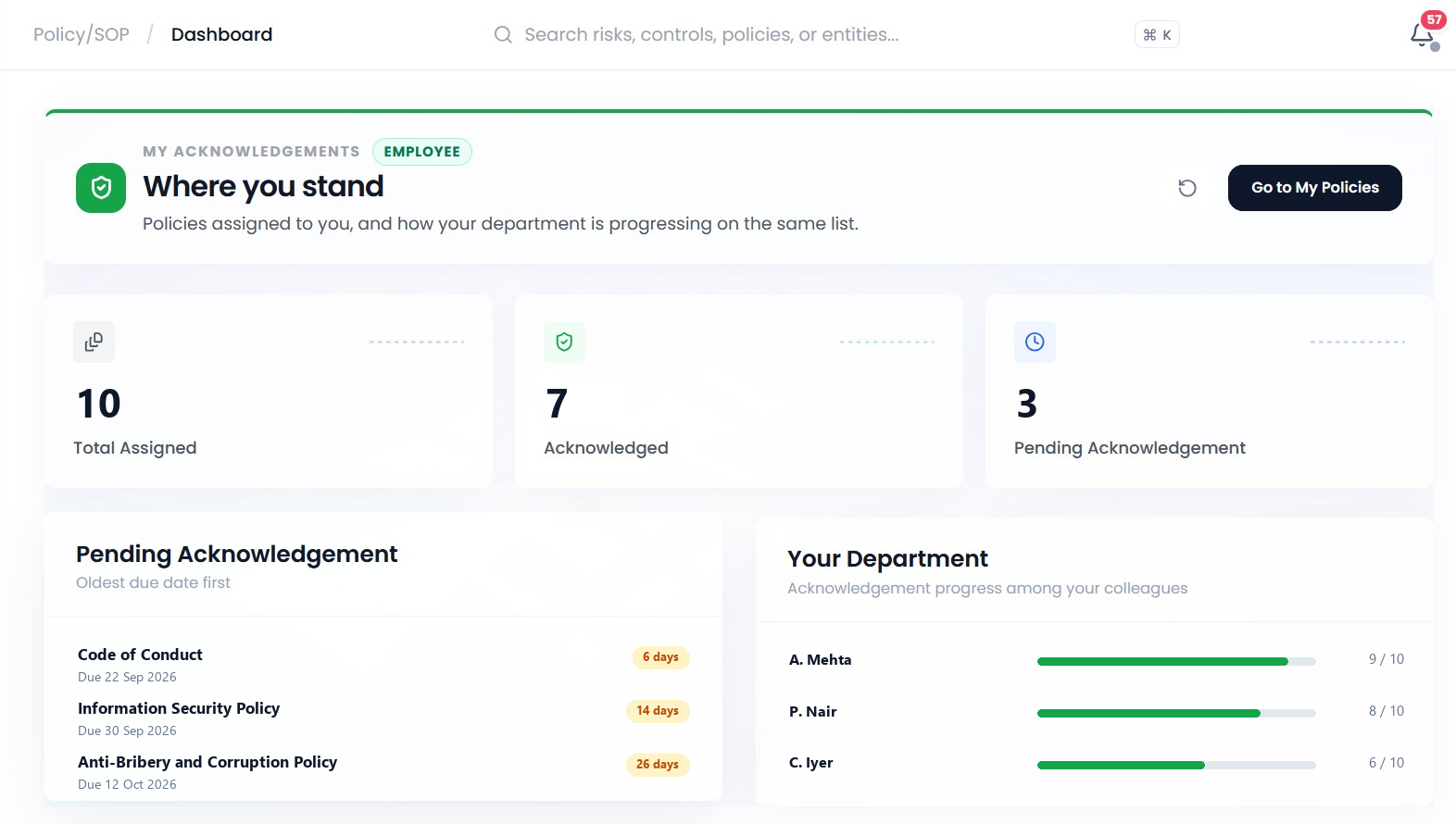
What is assigned to someone, what they have acknowledged and what is still outstanding — with the pending policies listed oldest due date first, and the same list tracked across the department. This is the view that turns acknowledgement from an assumption into a record.
The steps in the order your team will actually work through them.
The owner drafts against the approved template and the document numbering convention.
Reviewers comment on the draft in place, and the comments stay with the version they relate to.
The approving authority signs off, and the approval reference and date are recorded against the version.
The document goes live with an effective date, and the previous version is superseded and archived.
The applicable audience reads and acknowledges, with reminders until the record is complete.
The next review date comes up on its own; the document is reaffirmed, revised or retired.
The records the module produces, and the regulations and frameworks they help you meet.
These references describe the context the module is designed to support. They are not a statement of certification, and do not replace professional judgement on your reporting obligations.
Everyone works on the same record. Each person sees the part they are responsible for.
Don't see your question here? Write to us and we'll answer it for your setup.
Yes. Numbering conventions, categories and templates are configured to your framework, and existing documents retain their numbers when they are brought into the library.
A published document is assigned to its applicable audience, and each person's acknowledgement is recorded with a timestamp. Pending acknowledgements are reportable and can be reminded automatically.
Yes. Superseded versions are archived with their effective and supersession dates, so it is possible to establish which version was in force on a given date.
For any document, the auditor can be shown the current version, who approved it and when, the change history, the acknowledgement position and the controls it governs — without assembling it from separate sources.
Book an hour with our team. We will run the module on your own process and control matrix, so you can see how a full cycle would look for you.